
PPP Ecosystem
Public sector stakeholders collaborate comprehensively at every strategic stage of public initiatives.
Strategic Leadership
This process is led by the Contracting Public Entity (CPE) —ministries, decentralized institutions, state-owned enterprises, or municipalities— ensuring the feasibility of each project through to its implementation.
Main Ecosystem Actors
Responsibilities and frameworks under Law No. 93
Governing Body
Approves or rejects initiatives proposed by the CPE or the Cabinet Council to be implemented under the PPP model, among other functions.
More about the Governing Body →SNAPP
Acts as a liaison between the CPE and the Governing Body. Provides technical support throughout all project stages and operational support to the Governing Body. It does not propose or implement projects.
SNAPP Functions (PDF) →Contracting Public Entity (CPE)
Identifies projects with PPP potential, prepares technical reports, and is responsible for proposing, structuring, implementing, and supervising projects.
CPE Functions (PDF) →MEF
Coordinates the methodology to evaluate the project’s impact on public expenditure and on the General State Budget during the term of the contract.
MEF Functions (PDF) →Comptroller General
Countersigns contracts and their amendments. Oversees CPEs in contract execution in accordance with Law No. 32 of 1984 and Law No. 351 of 2022.
Claim Bodies (DGCP / TACP)
DGCP: Resolves claim actions in a single instance.
TACP: Resolves appeals filed by bidders.
Subject to procedures under Law No. 22 of 2006.
PPP Ecosystem
The different public sector actors that are part of the PPP Ecosystem are involved in all phases of a public initiative, from its identification, structuring, design, implementation, and supervision by the Contracting Public Entity (CPE) to its potential implementation in the country as a Public-Private Partnership (PPP) project.
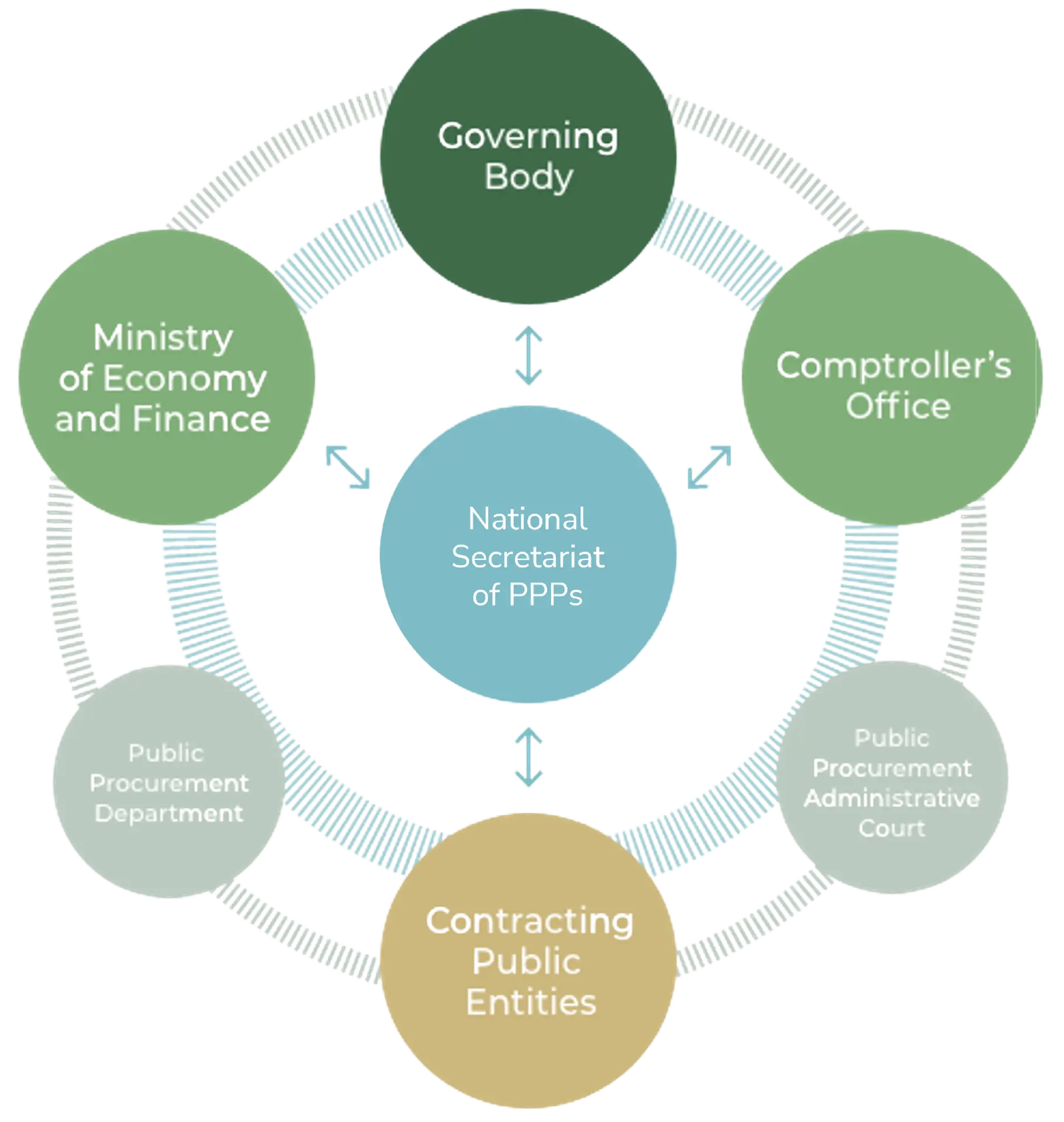
Governing Body
Approves or rejects the initiatives proposed by the Contracting Public Entities (CPE), through the SNAPP, or those considered by the Cabinet Council to be implemented under the PPP modality, among other functions.
National Secretariat of Public-Private Partnerships (SNAPP)
Acts as a liaison between the Contracting Public Entities (CPEs) and the Governing Body. The National Secretariat of PPPs (Secretaría Nacional de Asociaciones Público-Privadas, SNAPP) provides technical support to the CPEs in the identification, planning, formulation, structuring, bidding, and execution stages of PPP projects and provides operational support to the Governing Entity, among other functions. It does not propose or implement PPP projects.
Contracting Public Entity (CPE)
Identifies projects in its portfolio with potential for implementation under the PPP modality. Prepares the corresponding technical reports for submission to the Governing Body, through the SNPPP, for evaluation and potential approval. It is responsible for proposing, designing, structuring, implementing and supervising PPP projects, among other functions.
Ministery of Economy and Finance (MEF)
Coordinates, together with the SNAPP, the methodology to be used to evaluate the impact of the PPP project on the specific public expenditure of the Contracting Public Entity and on the General State Budget, during the term of the PPP contract, among other functions.
Comptroller General of the Republic
Countersigns PPP contracts and their modifications, if any. Oversees the Contracting Public Entities in the execution of PPP contracts, as established in Law No. 32, 1984, Organic Law of the Comptroller General of the Republic, amended by Law. 351, 2022.
General Directorate of Public Contracting
Responsible for resolving, in sole instance, claim actions within the PPP processes, subject to the deadlines and procedures established by Law No. 22, 2006.
Administrative Tribunal for Public Contracting
Responsible for resolving, if any, the appeals filed by bidders in the bidding processes of PPP contracts, subject to the terms and procedures established by Law No. 22, 2006.